
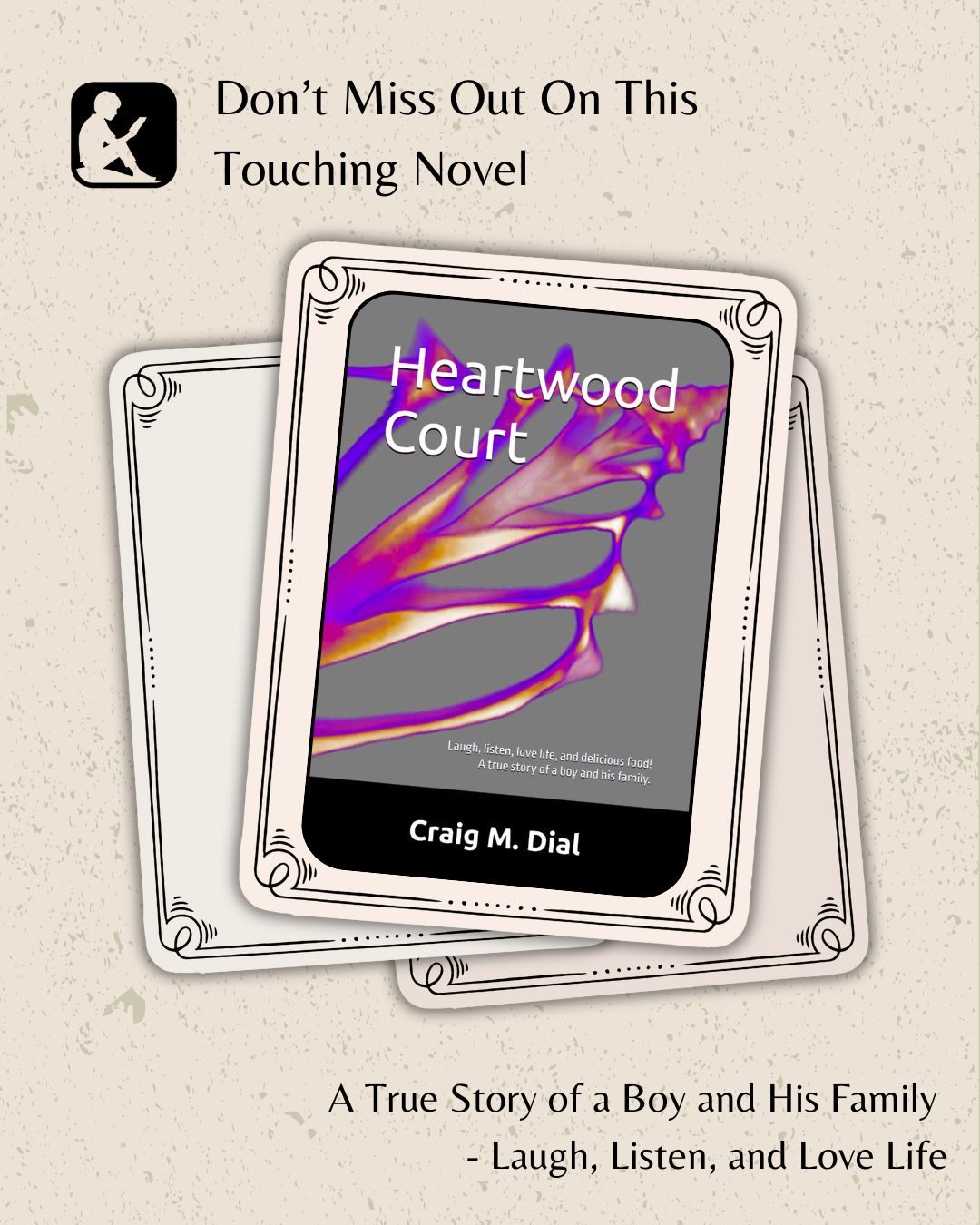
About the Book, Heartwood Court

Bell Tower
In the backdrop of 1970’s culture, music and fashion, young Craig navigates growing up as the middle child within a family of seven. Craig loves his mom’s cooking and tries his best to understand his complicated relationship with his father. He tries to find his place amongst his siblings, but his older brother, David seems to dislike his younger brother until one day a tragic event occurs and David reveals his love for Craig in the most unexpected way.
Heartwood Court Review
I was compensated with a small amount for my time and effort in reading the book and writing this review. However, all thoughts and opinions expressed are my own and are based on my honest personal experience reading the book. Nor did the publisher in any way, shape, or form ever pressure me to give a positive review.
The writing style of Heartwood Court feels almost like reading through a diary. As a book, it does not follow a rigid or traditionally plotted structure, but instead unfolds through memory, observation, and reflection, which makes sense considering its non-fiction aspect. Craig’s voice is intimate and personal, as if he is simply recording what he remembers as it comes to him rather than shaping those memories into a clean narrative arc. That approach makes the book feel raw and lived in, which works especially well for a memoir that is rooted so deeply in childhood perception.
Across the narrative, the story follows Craig as he navigates fear, admiration, and resentment toward his older brother David, while combing through his childhood. However that family is far from perfect, as seen from their attitude towards David’s treatment of craig. Although Craig touches on many different themes throughout the book, it is undeniable that David is the most impactful presence shaping his emotional world.
Which naturally brings me to the elephant in the room that is David. Oh David, David, David (shakes head). I want to be more reserved with my criticism here because this is a non-fiction book, and these are real people being written about. That said, reading purely from an outside perspective and being completely detached from Craig and his family, David comes across as genuinely horrible, especially in the way he treats Craig. Throughout the book, I found myself feeling deeply concerned for Craig. Beyond the obvious mistreatment on David’s part, what made it even more painful to read was Craig’s own internal dismissal of the severity of that behavior. Seeing him minimize what was happening to him was, in many ways, more upsetting than the cruelty itself.
At the same time, I can understand this when I take into account child psychology, family dynamics, and trauma bonding. No adult ever truly steps in in a meaningful way. David is not punished, disciplined, or properly corrected. As a result, Craig seems to internalize the idea that this is simply how family works. That normalization allows David’s abnormally cruel behavior to persist unchecked, and Craig grows up adapting himself around it rather than questioning it.
As the book continued, what I became most interested in was how Craig’s attitude toward David would ultimately change. From what I can see, he does not truly forgive David in a traditional sense. Instead, what he does is release himself from the need for resolution. That distinction is important. There is no confrontation, no apology, no clear reckoning. There is simply acceptance of ambiguity.
Initially, I found this surprising because it violates a common…expectation we have in stories like this, and it’s that abusers must be hated with no black and white But real life, without making statements what is right or wrong, it is messier than that. Craig’s attachment to David is complicated and, unfortunately, understandable. They are blood related, David is older, more powerful, and someone Craig admires despite the harm he does to him.
Ultimately, Heartwood Court touches on many themes, but my biggest takeaway is how children can bond deeply to people who hurt them. As a book coming more from the reflection of the author himself, Heartwood Court does not offer neat closure or moral clarity. Instead, it presents an uncomfortable emotional truth about family, memory, and the ways love and harm can coexist, especially when viewed through the lens of a child. As well as how an adult feels looking back on it.
Check Out Some of My Other Book Recommendations
About the Author of Heartwood Court, Craig M. Dial

Leave a Reply